Table of Contents
Explanation of Key Trends - Nitrogen Oxides
Obligations
Within the scope of the LRTAP Convention, the Federal Republic of Germany was obliged to reduce emissions of NOx to the 1987 level of 3,177kt by 1994. However, this value is inconsistent with the time series data after 1990 because, for example, it does not include any emissions from the agricultural sector. But emissions were successfully reduced by close to 30% to 2,255 kt in this period, exceeding the obligatory requirements of the protocol and also meeting the additional voluntary commitment that was entered into by Germany and 11 other ECE countries (reduction of NOx emissions before 1998 by 30% compared to 1986 levels).
More recently, Germany has made a commitment under the multicomponent protocol to further minimise NOx emissions. By 2010, it will no longer be permissible to exceed a National Emission Ceiling of 1,081kt NOx for Germany as whole. The revised Gothenburg Protocol and the revised NEC Directive both define emission reduction targets relative to a 2005 base year, mandating 39% (2020) and 65% (2030) reductions respectively.
While Germany's compliance with these obligations is not discussed here, further information on this subject can be found in Chapter 10 - Projections and Chapter 12 - Adjustments and Emission Ceiling Exceedance.
Main drivers
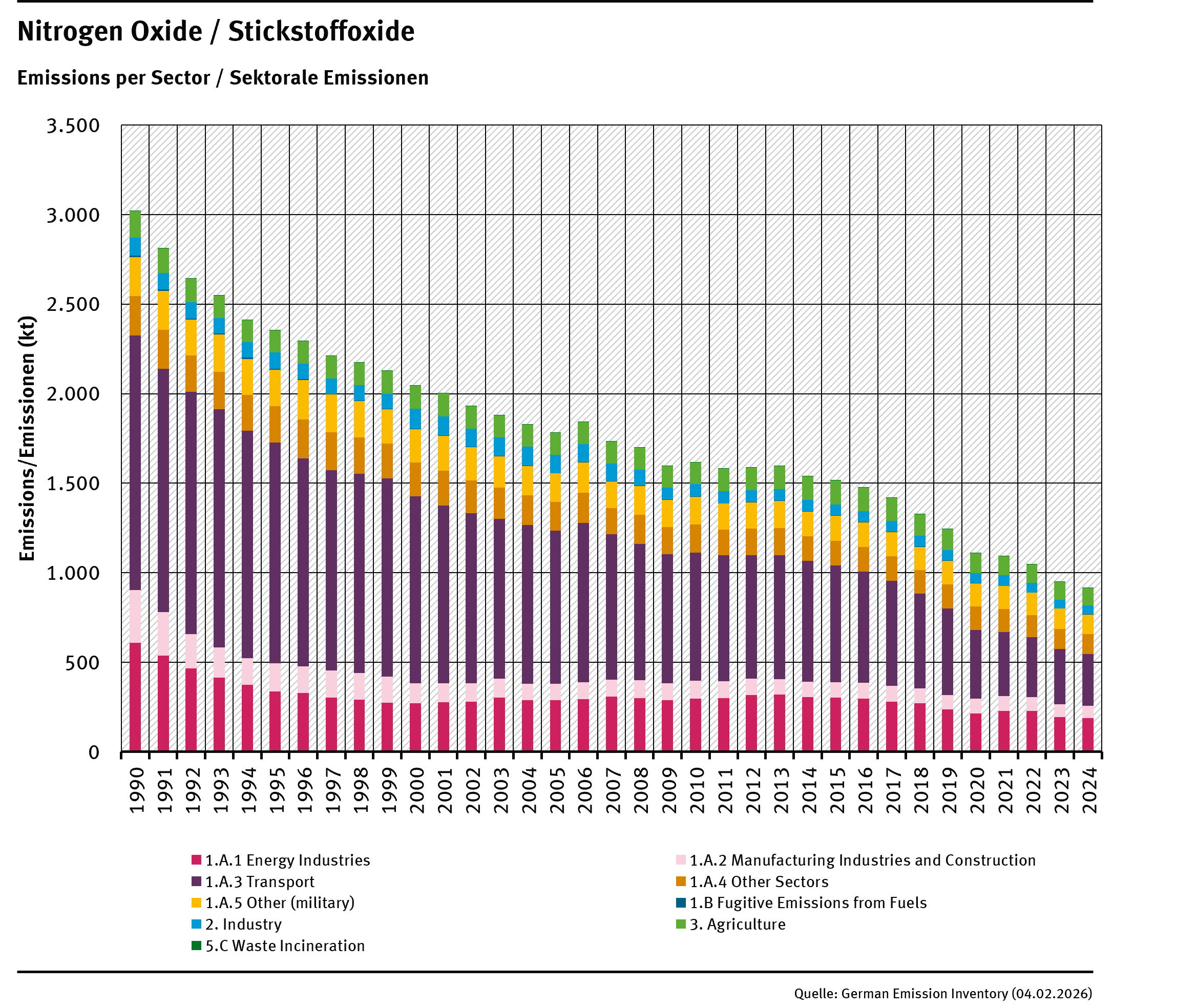
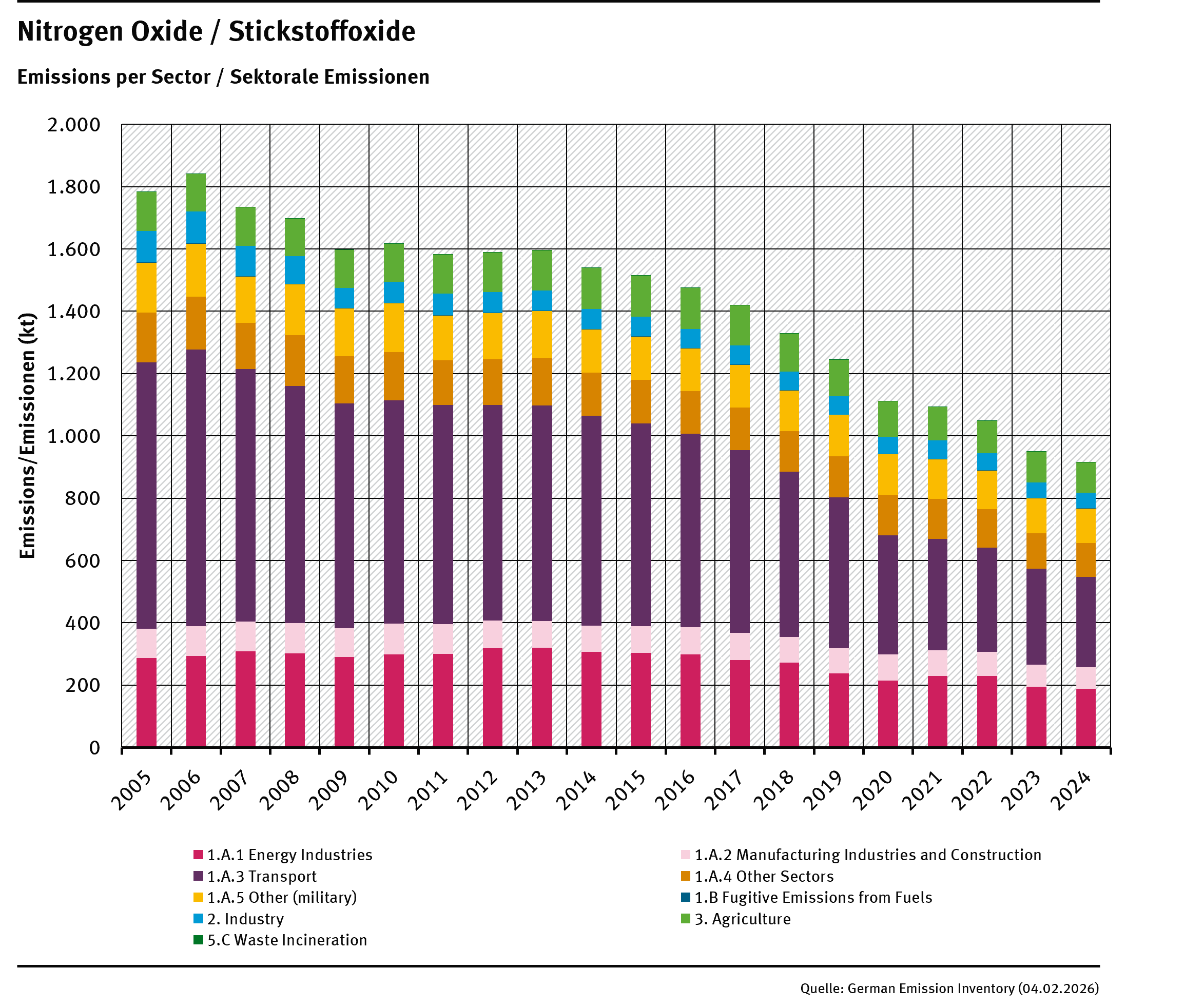
NOx total emissions show a falling trend from 1990 onwards, with emission reductions of 71.6% between 1990 and 2024 and steadily falling emissions in the last years.
Main driver for NOx emissions is Fuel Combustion (NFR 1.A) with over 91% of 1990 emissions and a 75% reduction from 1990 to 2024. About half of the 1990 emissions from NFR 1.A and a similar reduction (-81%) between 1990 and 2024 comes from Road Transportation (NFR 1.A.3.b), mainly due to increasingly stricter regulations resulting in technical improvements.
The rest of the 1990 emissions mainly comes from Energy Industries (NFR 1.A.1) with a 23% share of 1990 Fuel Combustion (NFR 1.A) emissions and a 69% reduction and, to a lesser extend, from Manufacturing Industries and Construction (NFR 1.A.2) with an 11% share and 69% reduction followed by Other Sectors (NFR 1.A.4) with a share of 8% and a 50% reduction between 1990 and 2024. For NFR 1.A.2, some emissions were reassigned to the Industrial Processes (NRF 2) starting from the year 2000, leading to lower emissions from NFR 1 and a similar rise in NFR 2.
Table: NOx emissions 1990-2024, in kilotonnes [kt]
| Trend: latest compared to | ||||||||||||||||
|---|---|---|---|---|---|---|---|---|---|---|---|---|---|---|---|---|
| 1990 | 1995 | 2000 | 2005 | 2010 | 2015 | 2016 | 2017 | 2018 | 2019 | 2020 | 2021 | 2022 | 2023 | 2024 | 1990 | previous year |
| 2 850 | 2 173 | 1 871 | 1 634 | 1 468 | 1 381 | 1 343 | 1 286 | 1 201 | 1 115 | 983 | 969 | 928 | 841 | 809 | -71.6% | -3.8% |