
meta data for this page
Explanation of Key Trends - Fine Particulate Matter (PM₂.₅)
Obligations
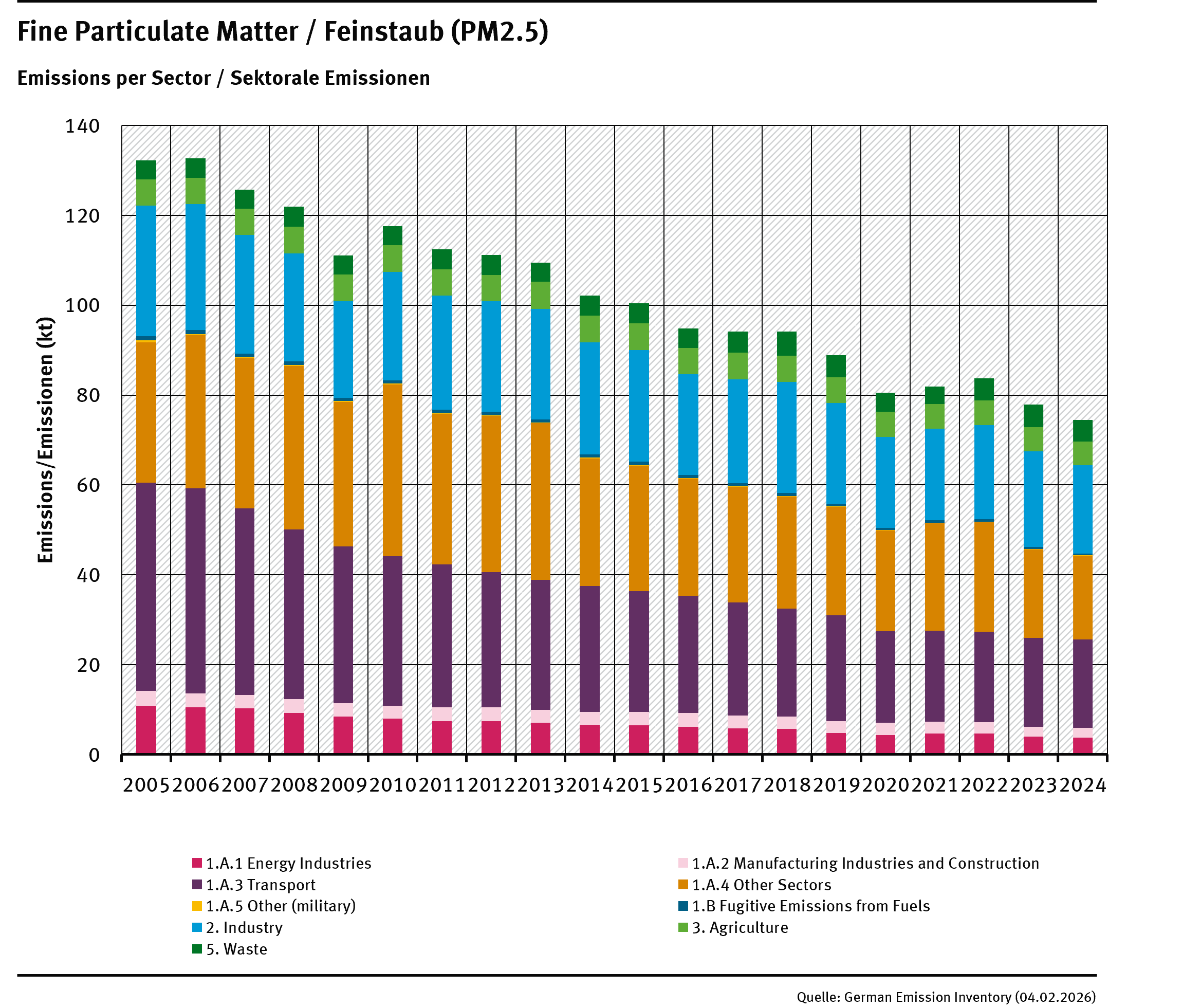
Germany has made a commitment to reduce particulate matter emissions. The revised Gothenburg Protocol and the revised NEC Directive both define emission reduction targets relative to a 2005 base year, mandating 26% (by 2020) and 43% (by 2030) reductions respectively.
While Germany's compliance with these obligations is not discussed here, further information on this subject can be found in Chapter 9 - Projections and Chapter 11 - Adjustments and Emission Ceiling Exceedance.
Main drivers
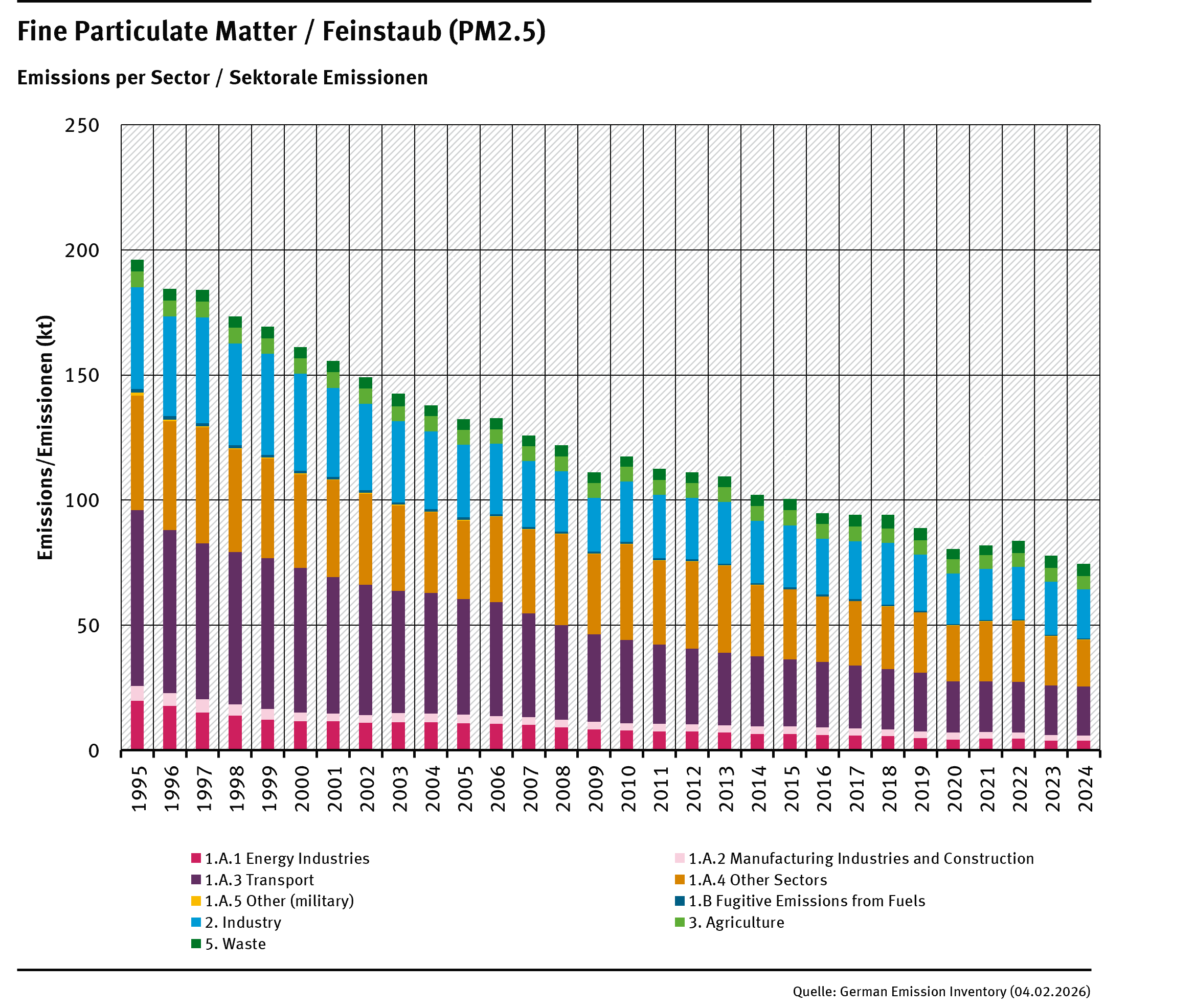
Between 1995 and 2024, Total PM2.5 emissions declined by 62.0%.
The main drivers for PM2.5 emissions are Fuel Combustion (NFR 1.A) with 73% of total 1995 emissions and a 69% reduction between 1995 and 2024 and, as a sum, the Industrial Processes (NFR 2) with about 21% of total 1995 emissions and a 52% reduction between 1995 and 2024.
Within both National totals and NFR 1.A, Transport (NFR 1.A.3) is responsible for the biggest part of PM2.5 emissions. Here, about 88% of 2024 PM2.5 transport emissions are induced by Road Transport (NFR 1.A.3.b). About one quarter (25%) of these emissions are directly caused by fuel combustion (NFRs 1.A.3.b.i-iv) whereas 75% stem from tyre and brake wear (1.A.3.b.vi) and road abrasion (vii).
Table: PM2.5 Emissions 1990-2024, in kilotonnes [kt]
| Trend: latest year compared to… | ||||||||||||||||
|---|---|---|---|---|---|---|---|---|---|---|---|---|---|---|---|---|
| 1995 | 2000 | 2005 | 2010 | 2015 | 2016 | 2017 | 2018 | 2019 | 2020 | 2021 | 2022 | 2023 | 2024 | …BY (1995) | …previous year | |
| 196 | 161 | 132 | 118 | 100 | 95 | 94 | 94 | 89 | 80 | 82 | 84 | 78 | 74 | -62.0% | -4.4% | |